A strong foundation, but not enough momentum:
Switzerland under pressure in the digital financial market
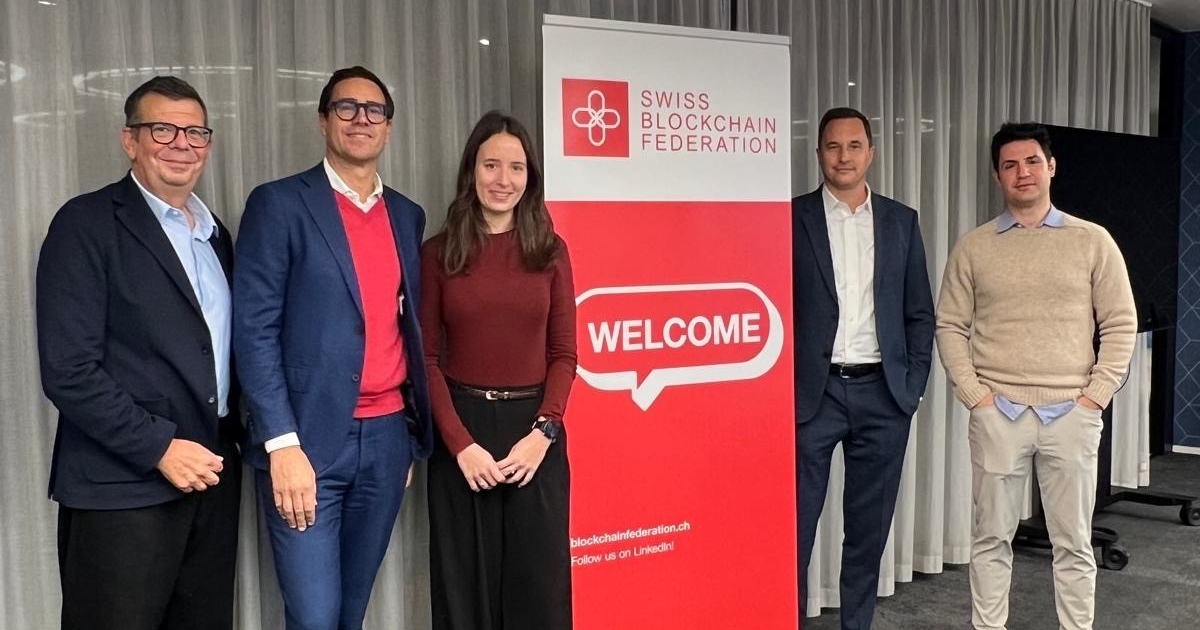
from left to right: Pascal Ihle (SBF), Andreas Glarner (Legal Partner MME), Sofia Nicoli (SBF), Thomas Linder (Tax Partner MME), Cédric Osivandi (Global Head Legal AMINA Bank)
- The Swiss Blockchain Federation (SBF) has published its first global benchmark report, ‘Infrastructure first’. It compares 15 international financial centres and ranks Switzerland sixth.
- Switzerland has a strong foundation but needs to catch up. It is well positioned in terms of legal certainty and digital market infrastructure. However, Switzerland is losing ground when it comes to pace, connectivity and scalability.
- The SBF is calling on Switzerland to step up a gear: faster regulatory procedures, better market access and a clear strategic positioning for institutional digital assets.
Zurich, 3 November 2026 – Securities, bonds, funds and means of payment can now be tokenised. Ownership and payment rights are represented in digital units, known as tokens, and transferred via a regulated blockchain infrastructure. A global race has therefore begun to see who will build, operate and shape the standards of this infrastructure. This is about far more than just technology: it is about value creation, skilled jobs and strategic influence in the financial system of the future. The stakes are high for Switzerland.
A wake-up call for Switzerland
This is precisely why the Swiss Blockchain Federation, with the support of AMINA Bank and MME, has produced the “SBF Global Benchmark Report 2026: Infrastructure first”. The study answers the strategic question of where the next-generation regulated financial market infrastructure will emerge — and whether Switzerland will retain a leading role in this development.
The result is a wake-up call: Switzerland ranks sixth out of the 15 global jurisdictions examined. Ahead of it are the US, Singapore, the UK, Germany and Japan; Luxembourg follows closely behind. The study compares the locations across 11 dimensions, highlights their respective strengths and weaknesses, and derives from this analysis a concrete strategic agenda for Switzerland.
World-class fundamentals — room for improvement in pace, connectivity and scaling
Switzerland continues to have exceptionally strong fundamentals. These include an early DLT legal framework, legal clarity, a regulated digital market infrastructure, specialised banks and custodians, as well as a first-class research landscape and a broad ecosystem. However, the lead it once enjoyed is dwindling. Other financial centres have learnt from Switzerland’s strengths and are now translating them more quickly into market-oriented solutions, international connectivity and new applications.
The study identifies three areas where Switzerland needs to catch up most urgently. First, there is a lack of implementation momentum; the next step in regulatory development is taking too long. The revision of the Financial Institutions Act (FINIG), the lack of a practical regulatory framework for CHF-pegged stablecoins and the unpredictable procedures of the Swiss Financial Market Supervisory Authority (FINMA) are hindering the translation of legal clarity into new business models and productive applications.
Second, there is a lack of market depth, liquidity and international connectivity. The Swiss domestic market is structurally small. It is therefore crucial that Swiss market infrastructures, banks and custodians become capable of cross-border integration and gain access to international issuers, investors and trading venues. Without this connectivity, even a first-class infrastructure will fail to realise its full potential.
Third, there is a need to catch up in the areas of AI × Blockchain and Talent. Switzerland is strong in research and education. However, it still too rarely translates this strength into scalable applications for compliance, risk management, cyber resilience and settlement. In the future, competition will be decided not only by technology, but also by the ability to integrate it into regulated financial market processes.
Heinz Tännler, President of the Swiss Blockchain Federation: “This study makes it clear that the competition for the infrastructure of the next generation will not begin at some point in the future – it is already underway. Switzerland has a strong foundation. But we must not assume that legal quality and trust alone are sufficient. We must once again translate both more swiftly into international relevance, concrete applications and lasting value creation.”
Five recommendations from the SBF for the Swiss financial centre
- Strengthen innovation and pace at FINMA. Innovation should once again be explicitly enshrined as a strategic objective. Licensing procedures must become clearer, faster and more predictable.
- Create a practical framework for CHF-pegged stablecoins and digital forms of money. The framework must be technology-neutral, proportionate and risk-based, and must enable secure institutional applications.
- Improve international market access. Switzerland must pursue additional targeted market access agreements and could, for example, press ahead with the further development of the agreement with the United Kingdom on digital financial services.
- Deepen liquidity and market interconnectivity. Swiss market participants must gain access to international trading, custody and settlement platforms via interoperable links — and thereby to more issuers, investors and liquidity.
- Bring technology and talent to market more quickly. Research, the financial industry and infrastructure operators should work together to bring applications in AI × blockchain, compliance, cyber resilience and programmable settlement to market maturity.
These proposals do not aim to weaken supervision. They aim for a supervisory framework and legal regime that combine innovation, competitiveness and investor protection.
A Swiss niche rather than attempting to copy larger markets
The study does not recommend that Switzerland emulate New York, London or Singapore. Instead, its potential lies in establishing a clearly defined and defensible niche: as a trustworthy, neutral and internationally connected hub for institutional digital assets. This includes tokenised bonds, funds, collateral and private-market assets, institutional custody, as well as programmable, cross-border settlement.
What the study reveals
The “SBF Global Benchmark Report 2026” compares 15 global financial and DLT centres across 11 dimensions. It contains the rankings, country profiles, an analysis of Switzerland’s strengths and weaknesses, international case studies, and specific recommendations on regulation, digital forms of money, market access, interoperability, cyber resilience and the integration of AI x blockchain. It thus provides a fact-based foundation for policymakers, public authorities, the financial industry, technology companies and academia.
Franz Bergmüller, CEO of AMINA Bank: “The early digital asset licenses from FINMA in 2019 gave Switzerland a head start in digital regulation. That advantage is real and this report confirms those strengths. It also shows that others are accelerating. We rank sixth. At AMINA, we operate across four jurisdictions and can see that Switzerland’s starting position remains strong, but staying ahead requires matching the speed we see in other jurisdictions such as Hong Kong, the EU, the UAE, and the United States. Digital assets are here and now we need to turn up the volume.”
Dr Andreas Glarner, Legal Partner, and Thomas Linder, Tax Partner, MME: “Switzerland should once again aspire to set global standards in the field of digital assets. To achieve this, we need a reliable legal framework that assesses digital assets according to their actual functions. Regulation should enable innovation, not play catch-up with it.”
The SBF Global Benchmark Report 2026 is available at https://blockchainfederation.ch/shop/
###
About the Swiss Blockchain Federation
The Swiss Blockchain Federation (SBF) is a public-private initiative aimed at promoting innovation in the field of blockchain and digital assets. It brings together representatives from business, government, academia and civil society with the aim of strengthening Switzerland’s appeal and international competitiveness as a blockchain hub. Acting as a link between business, regulation and politics, the SBF advocates for legal certainty, an innovation-friendly framework and the widespread adoption of blockchain-based solutions. Through its specialist working groups, publications and political engagement, the Federation fosters expert dialogue, provides impetus for the strategic development of the sector and contributes to the long-term development of a dynamic and trustworthy blockchain ecosystem.